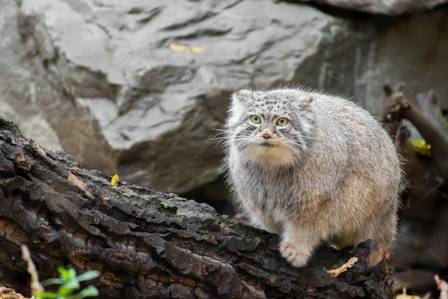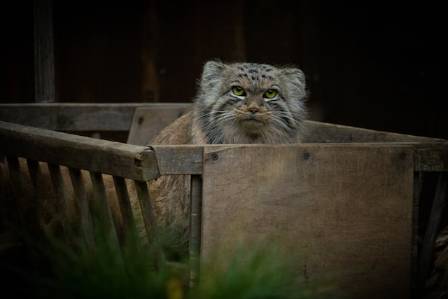
It may resemble the grumpiest domestic cat you’ve ever seen, yet this is the Pallas’s cat, a small wild feline renowned for its dense coat and unique facial features. Also called the manul, these elusive cats are perfectly adapted to life in the cold, rugged terrains of Central Asia.
These furry cats thrive in extreme climates
The vast Eurasian steppe spans millions of square miles of grasslands, savannas, and rolling hills, stretching from Iran to the eastern edges of China. Pallas’s cats are mostly found in rocky hills and low mountains within this region.
They possess the densest fur of any cat species, insulating them against temperatures as low as -50°C (-58°F). In the summer, when it can rise above 32°C (90°F), they shed most of their thick coat to stay comfortable.
Their build differs from housecats
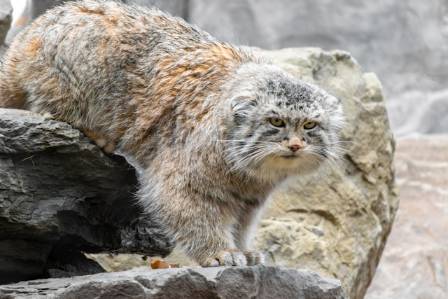
Though similar in size to domestic cats, Pallas’s cats are more robust, with stocky muscles and a thick fat layer. Short legs keep them low to the ground, helping them stalk prey effectively, even though they are not built for long-distance running.
Some scientists suggest their unusual facial structure is an adaptation to cold weather. Their flattened skulls and higher-set eyes help them see prey while lying close to the ground, often covered with snow.
They use bushy tails to keep their feet warm
During cold spells, Pallas’s cats curl their fluffy tails around their paws for insulation.
Masters of concealment
In the open steppe, where hiding spots are rare, Pallas’s cats must stay cautious to avoid predators such as steppe eagles. They use their camouflage by flattening their bodies against the ground, blending seamlessly with rocks and vegetation.
Effective hunters that maintain ecological balance
These cats are ambush predators. They inch forward with their low-set legs, pouncing at the perfect moment. By hunting rodents like pikas, voles, and mice, they play a crucial role in controlling populations in their ecosystems. A single adult can eat up to five small rodents per day.
Pallas’s cats do not meow
Unlike domestic cats, they communicate with honks, growls, and chirps. When frightened, their sound resembles a small dog yelp more than a traditional cat meow.
Their scientific name means “stumpy-eared cat”
While most felines are classified under Felis, the Pallas’s cat belongs to Otocolobus. “Oto” refers to the ear, and “colobus” means cut short, describing the cat’s small, rounded ears.
Not suitable as pets
Despite their appearance, Pallas’s cats are wild predators, highly territorial, and can become aggressive when threatened. They require specialized care and should only be housed in facilities with trained staff able to meet their behavioral and nutritional needs.
Population numbers are uncertain and declining
The IUCN classifies Pallas’s cats as “Near Threatened.” They face dangers from habitat loss, poaching, and accidental poisoning by farmers. They are elusive, nocturnal, and blend into their environment, making population counts difficult, though western populations appear to be decreasing.
See them in person at the Smithsonian National Zoo
Visitors to Washington, D.C., can meet a pair of Pallas’s cats, sisters Akar and Ceba, at the Smithsonian’s National Zoo and Conservation Biology Institute. Learn about their behavior and how the Smithsonian contributes to wildlife conservation globally.