Kangaroos are more than just Australia’s national symbol—they are extraordinary creatures shaped by millions of years of evolution, adapted to thrive in the continent’s diverse landscapes, from arid outbacks to lush rainforests. These charismatic marsupials are famous for their powerful hops, cozy pouches, and playful demeanor, but there’s far more to them than meets the eye. Below are 10 captivating facts that reveal the unique biology, behavior, and cultural significance of kangaroos.
Kangaroo Joeys: Tiny Jellybean-Sized Newborns
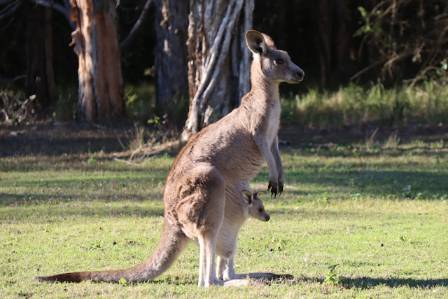
Baby kangaroos, known as joeys, are among the smallest newborn mammals on Earth. At birth, they weigh a mere 0.5 to 2 grams (less than an ounce)—about the size of a jellybean or a grape—and measure just 2 to 3 centimeters long. Born blind, hairless, and underdeveloped, joeys rely on instinct to crawl up their mother’s fur-covered belly and into her pouch, a warm, protected chamber lined with soft tissue. Once inside, they latch onto one of four teats, which swells in their mouth to keep them securely attached. Joeys spend the next 6 to 8 months developing inside the pouch, growing fur, opening their eyes, and gradually gaining strength. They begin to peek out of the pouch at around 4 months old, venturing out for short periods before returning to safety, and are fully weaned by 12 months. This remarkable early life cycle is a defining feature of marsupials, and kangaroos exemplify this adaptation perfectly.
They Can’t Move Backwards—A Symbol of Progress
One of the most unique physical traits of kangaroos is their inability to walk or hop backwards. This is due to their specialized anatomy: long, muscular hind legs designed for forward hopping, large feet with rigid toes that prevent backward movement, and a heavy, muscular tail that acts as a balance aid but not a prop for reversing. This quirk of nature has made the kangaroo a powerful symbol in Australian culture, representing a nation that “moves forward” without looking back. Alongside the emu (another bird that can’t walk backwards), the kangaroo adorns Australia’s Coat of Arms, a choice made in the late 19th century to embody progress, resilience, and national identity. While they can’t reverse, kangaroos are incredibly agile—they can turn quickly while hopping, pivot on one leg, and even move sideways to navigate tight spaces, making their forward-focused movement a strength rather than a limitation.
60 Species: From Giants to Miniatures
When most people think of kangaroos, they picture the iconic red or eastern grey kangaroo, but the kangaroo family (Macropodidae) is surprisingly diverse, with over 60 species ranging in size from towering giants to tiny marsupials. The largest is the red kangaroo (Macropus rufus), which can stand up to 2 meters (6.5 feet) tall and weigh 90 kilograms (200 pounds), bounding across the Australian outback at speeds of up to 56 km/h (35 mph). At the opposite end of the spectrum is the musky rat kangaroo (Hypsiprymnodon moschatus), a diminutive species found in Queensland’s rainforests that weighs just 500 grams (1 pound) and is smaller than a rabbit. Between these extremes are wallabies (smaller kangaroos adapted to forests and grasslands), rock-wallabies (specialized for cliff habitats), and tree kangaroos (arboreal species). Despite their size differences, all macropods share key traits: powerful hind legs for hopping, a long tail for balance, and a pouch for raising young.
Tree Kangaroos: The Kangaroos That Climb
While most kangaroos are ground-dwelling, tree kangaroos (genus Dendrolagus) have broken the mold, evolving to live high in the rainforest canopies of Australia’s tropical north and New Guinea. These unique marsupials are adapted for arboreal life with several specialized features: sharp, curved claws for gripping tree trunks and branches, a long, prehensile tail (unlike ground kangaroos, whose tails are for balance rather than grasping) that acts as a fifth limb to anchor them in trees, and shorter, broader hind legs for climbing instead of hopping. Tree kangaroos can leap up to 9 meters (30 feet) from one tree to another and descend headfirst down trunks, using their claws to control their speed. They feed on leaves, fruit, and bark, and spend most of their lives in trees, only descending to the ground occasionally to move between habitats. Unfortunately, many tree kangaroo species are endangered due to deforestation and habitat loss, making their conservation a priority.
Powerful Hops: The Most Efficient Way to Move
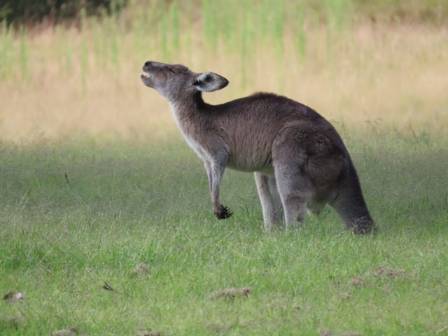
Kangaroos are the only large mammals that move primarily by hopping, a mode of locomotion that is surprisingly energy-efficient. Their hind legs are equipped with massive muscles and elastic tendons that act like springs: when a kangaroo lands, the tendons stretch and store energy, which is then released to propel them forward in the next hop. This “elastic recoil” means that kangaroos use less energy at higher speeds—unlike most mammals, which burn more energy as they run faster. A large red kangaroo can leap up to 8 meters (25 feet) in a single bound and reach speeds of 56 km/h (35 mph) over short distances. For comparison, a human would need to take 10 to 12 steps to cover 8 meters, and even the fastest human sprinters top out at around 45 km/h (28 mph). This efficient movement is perfectly suited to Australia’s vast, arid landscapes, allowing kangaroos to travel long distances in search of food and water with minimal energy expenditure.
Embryonic Diapause: Pausing Pregnancy at Will
Female kangaroos possess a remarkable biological superpower: the ability to pause the development of their embryos in a process called embryonic diapause. This adaptation allows them to delay giving birth until conditions are optimal for raising a joey. Here’s how it works: after mating, a fertilized egg develops into a tiny embryo (about the size of a grain of rice) but then stops growing. If the female’s pouch is empty (i.e., her previous joey has left for good) and food is abundant, the embryo resumes development, and she gives birth after a gestation period of just 33 days. However, if she still has a young joey in her pouch or if food is scarce, the embryo remains dormant—sometimes for months. This ensures that the female doesn’t have to care for two joeys at once (one in the pouch and one newborn) and that her offspring are born when they have the best chance of survival. It’s a brilliant survival strategy that has allowed kangaroos to thrive in Australia’s unpredictable climate.
The Tail: A Muscular Fifth Limb
A kangaroo’s tail is far more than a balancing tool—it’s a powerful, muscular appendage that functions as a fifth limb. Composed of strong tendons and muscles (it contains nearly 20 vertebrae, more than most mammals), the tail can support the kangaroo’s entire body weight. When moving slowly (a behavior called “crawling” or “pentapedal locomotion”), kangaroos use their tail and forelimbs to propel themselves forward, dragging their hind legs behind them. This mode of movement is energy-efficient for short distances and allows them to graze close to the ground. The tail is also a critical weapon in male kangaroo “boxing” matches, which occur when males compete for mates or dominance. During a fight, a male will lean back on his tail, lifting both hind legs to deliver powerful kicks to his opponent, using his tail as a stable base. Additionally, the tail helps kangaroos maintain balance while hopping at high speeds and acts as a rudder to steer turns.
The Name “Kangaroo” Comes From an Aboriginal Word
Kangaroos have deep cultural and spiritual significance for Australia’s Aboriginal and Torres Strait Islander peoples, who have coexisted with these animals for over 60,000 years. Kangaroos feature prominently in Aboriginal dreamtime stories, rock art (some dating back 20,000 years), and ceremonies, representing strength, abundance, and connection to the land. The English name “kangaroo” traces its origins to an Aboriginal word from the Guuga Yimithirr people of Queensland’s tropical north. When Captain James Cook’s expedition encountered kangaroos in 1770, they asked the local people what the animal was called. The response, “gangurru,” referred specifically to the eastern grey kangaroo, but the sailors misinterpreted it as the name for all kangaroos. Over time, “gangurru” evolved into “kangaroo” in English, becoming one of the most recognizable Aboriginal loanwords in the language. For Aboriginal communities, kangaroos are not just animals—they are part of their cultural identity and a source of food, fur, and tools.
Social Groups: Mobs, Troops, or Courts
Kangaroos are highly social animals that live in groups known as mobs, troops, or courts. The size of these groups varies by species and habitat: some mobs have just a few individuals, while others can number in the hundreds (especially in areas with abundant food and water). Mobs are typically led by a dominant male (called a “boomer”), who defends his group from other males through boxing and kicking. Female kangaroos (called “flyers”) and their joeys form the core of the mob, and they communicate with each other using a range of sounds and body language. Nose-touching is a friendly greeting, while stomping their hind legs on the ground is a warning signal (alerting the mob to predators like dingoes or eagles). Males may growl or hiss to assert dominance, and mother kangaroos use soft clicking or clucking sounds to call their joeys back to the pouch. Living in groups provides safety in numbers, helps with finding food, and facilitates mating opportunities.
Joeys Dive Headfirst Into the Pouch for Safety
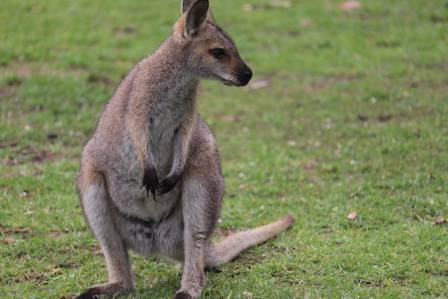
Despite their small size and underdeveloped bodies, joeys have an amazing instinct for self-preservation: when threatened, they dive headfirst into their mother’s pouch at lightning speed. This behavior, called “pouch diving,” is crucial for their survival in the wild. Even when the mother is hopping at full speed, a young joey can somersault into the pouch, using its strong forelimbs to pull itself inside. Once inside, it squirms around to turn right-side-up and latch onto a teat, safe from predators. As joeys grow larger and can no longer fit entirely in the pouch, they will still dive in headfirst, leaving their hind legs hanging out, until they are too big to use the pouch at all (usually around 8 to 10 months old). This quick escape reflex is a testament to the joey’s instinctual drive to survive and the pouch’s role as a portable safe haven.