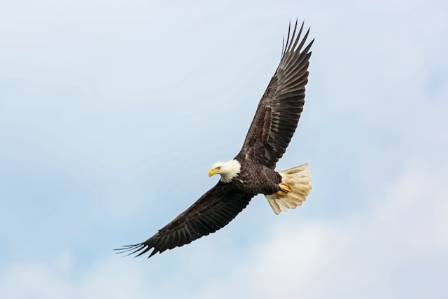
Out of more than sixty eagle species globally, only two inhabit North America, with the Bald Eagle being the most iconic. Long revered as a symbol of liberty and strength, this magnificent raptor is a permanent fixture in many lakeside regions. However, there is much more to this predator than its famous silhouette. Beyond its status as a national emblem, the Bald Eagle possesses extraordinary biological and behavioral traits that continue to fascinate observers.
Physical Stature and Aerial Capabilities
The Bald Eagle ranks among the largest birds of prey on the planet. These raptors can reach weights of 15 pounds and lengths between 28 and 38 inches. Their most striking physical feature is a wingspan that can extend up to 7.5 feet, significantly larger than that of an osprey or a red-tailed hawk. This massive surface area is perfectly designed for soaring, allowing the eagles to remain airborne for extended periods with minimal effort.
This expansive wingspan enables them to reach staggering altitudes. By utilizing thermal air currents to glide, Bald Eagles can soar to heights of 10,000 feet or more. This efficiency allows them to conserve vital energy for hunting and long-distance migration.
Sensory Precision and Power
While humans with perfect vision are often described as having "eagle eyes," the actual visual acuity of a Bald Eagle is roughly eight times stronger than ours. Their vision is often measured at 20/40 or 20/50, allowing them to identify small prey from two miles away with perfect clarity. Additionally, they possess a 340-degree field of vision, providing peripheral awareness that surpasses even that of many owl species.
Their physical strength is equally impressive, particularly in their talons. A Bald Eagle’s grip exerts approximately 400 psi of pressure, which is ten times more powerful than a human's squeeze. This crushing force is essential for snatching heavy fish from the water and maintaining a hold while flying. They are also known to use this strength and agility midair to harass other birds into dropping their prey, which the eagle then steals.

The Truth About Their Appearance and Namesake
Contrary to what the name suggests, these birds are not actually featherless on their heads. The "bald" designation comes from the Middle English word "piebald," which refers to something that is white or has white patches. Interestingly, younger eagles do not possess this famous feature immediately. They go through about four stages of molting and only develop their signature white-feathered head and tail when they reach four or five years of age.
Elaborate Courtship and Social Bonds
The mating rituals of Bald Eagles are legendary for their acrobatic intensity. Known as "sky dances," these displays involve high-speed chases and a dramatic maneuver where the pair locks talons at great heights and tumbles toward the earth, breaking apart only at the last second. They also engage in quieter bonding activities, such as preening each other and building nests together.
Once a pair is established, they typically remain together for the rest of their lives. These monogamous relationships can last up to 30 years. Each breeding season, the couple produces one to three eggs, and both the male and female share the responsibility of incubation, which lasts about 35 days.
Master Architects of the Avian World
Bald Eagles are responsible for constructing the largest nests of any bird species. These massive structures, known as aeries, are usually built in the tops of tall trees at heights ranging from 60 to 200 feet. A typical nest can measure up to six feet across and four feet deep, composed of sticks, grass, and twigs. Because they tend to return to the same nest for decades, adding new materials each year, these structures can become incredibly heavy and complex over time.
Growth and Human Impact
When young eagles, or eaglets, are ready to leave the nest at 10 to 14 weeks old, they undergo a process called fledging. Because they still rely on their parents for sustenance while learning to hunt, they usually stay within the vicinity of the nest for about a month after their first flight.
As apex predators, Bald Eagles have few natural enemies; however, human activity has historically been their greatest threat. In the mid-20th century, the use of pesticides like DDT led to a catastrophic decline in their numbers, causing them to disappear from many regions. Following the ban of DDT and the implementation of the Endangered Species Act in 1973, the population saw a triumphant recovery. Today, they are no longer classified as endangered, serving as a primary example of successful wildlife conservation.